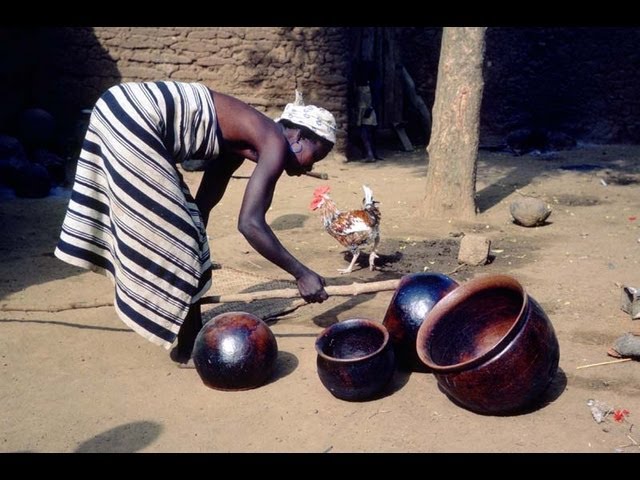
African Pottery Forming and Firing, shared by Christopher Roy, documents potters working in Burkina Faso, Ghana and Nigeria. The film provides an opportunity to study skilled hand movements, tools and processes across distinct West African pottery traditions.
Five forming techniques to observe
The source description identifies concave mould, convex mould, coiling, direct pull, and hammer-and-anvil techniques. It also includes two detailed firing sequences. Use these terms as an index for your viewing notes, rather than assuming that every potter or community works in the same way.
Concave and convex moulds: observe the shape of the supporting surface and how the clay is worked against it.
Coiling: follow how the vessel wall is built up and how joins are treated.
Direct pull: watch the relationship between pressure, hand position and the changing wall.
Hammer and anvil: note how the working tools support and shape the vessel.
From clay to finished vessel
Make a sequence of observations: preparation, forming, surface treatment, drying and firing. Record only the stages actually shown in each segment. If a step is omitted, mark it as “not shown” rather than filling the gap with an assumption.
The firing sequences can be studied for how vessels and fuel are arranged, how the work is shared, and how the makers judge progress. A documentary records a particular demonstration; it does not by itself establish a universal recipe, temperature or firing schedule.
Recognising cultural specificity
The film covers multiple places and communities. Keep the place names and maker identifications attached to each sequence when taking notes. Avoid presenting one example as the method of an entire country, or of Africa as a whole.
Tools and finished pots are only part of the story. Observe the maker’s decisions, coordination and experience. These provide a starting point for discussing craft knowledge, teaching and the relationship between an object’s form and its intended use.
Questions for study
Which movements are repeated, and which change as the vessel takes shape?
What similarities and differences can you document between two sequences?
What information would you need from the maker before attempting to reproduce a technique?
How should a museum, classroom or design project credit the people and traditions behind the work?