The Ancient Secret That Makes You Unbreakable | Tao Te Ching & The Physics of Water
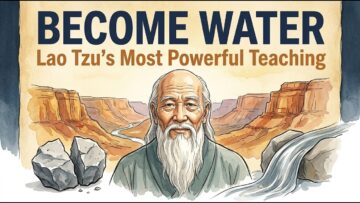
2,500 years ago, a philosopher living through one of the most violent eras in human history wrote a text that completely dismantled everything we believe about strength. Lao Tzu didn’t tell us to fight harder. He told us to look at water.
This video breaks down every time water appears in the Tao Te Ching — and what Lao Tzu was actually teaching us about power, ego, and survival. Not as poetry. As a mechanical system.
The Warring States period of ancient China ran for over 200 years. Every king, every general, every philosopher of the era believed the same thing: to survive, you had to be harder than your enemy. Thicker walls. Stronger swords. Heavier armor. The entire civilization was locked in an arms race of rigidity. And Lao Tzu watched all of it — and noticed that the hardest things were also the most fragile. A stone wall holds for months, then cracks. An iron sword shatters against rock. Rigidity requires enormous energy to maintain, and eventually, it always breaks.
So he looked to nature. He found water. And what he found changed everything.
What’s covered in this video:
Lao Tzu wrote the Tao Te Ching during the Warring States period, a 200-year era of constant warfare in ancient China where the dominant philosophy was that survival required maximum rigidity and force.
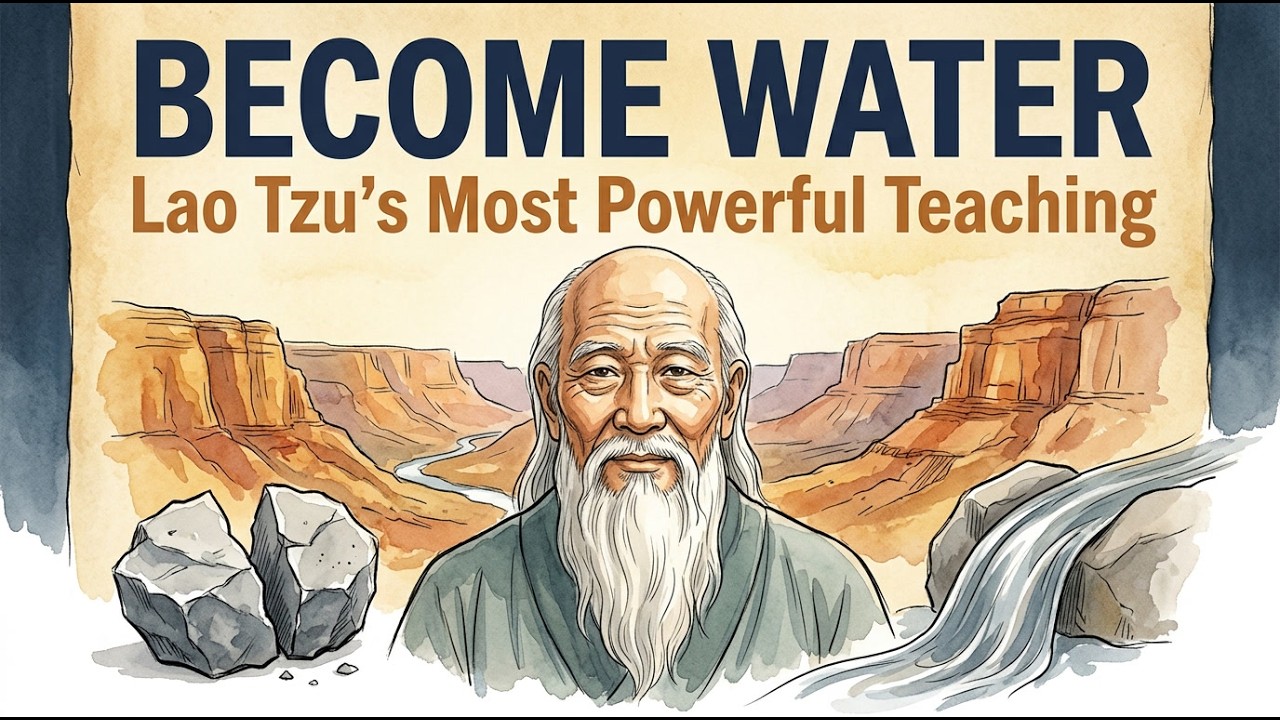
The first pattern of water identified in Chapter 43 is persistence over force — a single drop of water does nothing to granite, but falling on the same spot for a thousand years carves the Grand Canyon.
The second pattern is formlessness — water has no fixed shape, adapts to any container without friction, and never loses its essence. Bruce Lee’s “be water, my friend” was a direct reference to this Taoist principle.
The third pattern is stillness — the mind compared to a pool of water, where trying to force calm makes the mud worse, and Wu Wei teaches that the only way to clear muddy water is to leave it alone.
Chapter 8 contains Lao Tzu’s most famous definition of Wu Wei: “The supreme good is like water. Water benefits all things and does not compete with them. It settles in places that men reject.”
The valley versus the mountain — the peak is cold, isolated, and dead, while the valley receives all the water from all the mountains because it is willing to be at the bottom. Chapter 66 applies this to leadership: the sea is king of a hundred streams because it lies below them.
In the modern world, we wear iron armor in a world that requires us to swim — meeting anger with walls, hitting dead ends with more force, and trying to suppress anxiety by fighting it.
The practical application of Wu Wei: yield to anger instead of becoming a wall for it to crash against, flow around obstacles like a river instead of smashing through them, and observe anxiety without identifying with it until the mud settles on its own.
Mentioned in this video: Tao Te Ching, Lao Tzu, Wu Wei, Taoism, Warring States period, ancient China, Bruce Lee, Chapter 8, Chapter 43, Chapter 66, Grand Canyon, the valley principle, formlessness, ego, stillness, persistence, water philosophy, Eastern philosophy.
Timestamps:
00:00:00 – The lie the modern world taught you about strength
00:01:25 – The world Lao Tzu was living in: the Warring States period
00:03:07 – Why Lao Tzu chose water
00:03:59 – Pattern 1: Persistence over force (Chapter 43)
00:05:19 – Pattern 2: Formlessness and the absence of ego
00:06:51 – Pattern 3: Stillness and the muddy pool
00:08:12 – Where water goes: the physics of the valley
00:09:43 – The mountain is dead. The valley is alive.
00:11:25 – How we live today: iron armor in a world that requires swimming
00:12:38 – How to actually become water in the modern world
00:13:56 – The ultimate key Lao Tzu handed us